Academic Subject Areas: Financial Literacy, Life Skills, Money
What You’ll Need
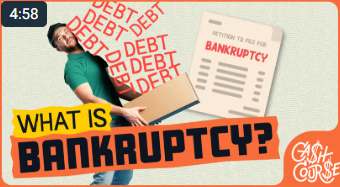
Video: Ca$h Cour$e: What Is Bankruptcy? (Watch Here)
Worksheet: Ca$h Cour$e: What Is Bankruptcy (Click Here)
Classroom whiteboard and dry-erase markers
Student whiteboards, notebooks, or pieces of paper
Lesson Plan (45 mins.)
Warm-Up: (15 mins.)
Begin with a quick word association activity. Write “Bankruptcy” on the board and ask students to call out words or phrases that come to mind. Note their responses on the board. Explain that bankruptcy is the legal process for forgiving debts, granting people a fresh start. Scan to watch episode:
Present a short, hypothetical scenario about a young entrepreneur facing financial difficulties. Ask students to discuss in small groups: ○ What could be some reasons for the entrepreneur’s financial troubles? ○ What might be some consequences if the situation isn’t resolved? ○ Do they think bankruptcy is a viable option?
After allowing a few students to share their group responses, provide a summary that acknowledges the variety of possible reasons and outcomes discussed.
Explain that today’s lesson will explore the concept of bankruptcy more deeply, using the Ca$h Cour$e video. Briefly outline the objectives for the day, such as defining key terms, understanding different types of bankruptcy, and recognizing the implications of declaring bankruptcy. Watch and Discuss (15 mins.)
Show the video Ca$h Cour$e: What Is Bankruptcy? Encourage students to take notes, especially on the different types of bankruptcy and key terms.
After the video, facilitate a discussion based on the notes students took. Guide the conversation towards understanding the different types of bankruptcy mentioned (Chapters 7, 13, and 11) and how they apply to the scenarios and people discussed in the video.
Use guided questions like: ○ What are the differences between Chapter 7, 13, and 11 bankruptcies? ○ How could the historical figures mentioned have benefited from modern bankruptcy laws? ○ Why is it important for everyone to understand bankruptcy? Wrap-Up: (15 mins.)
Distribute the “Ca$h Cour$e: What Is Bankruptcy? Worksheet,” which can be collected as a formative assessment. Ask students to complete the worksheet (individually, in pairs, or in a small group).
Pose the enduring question, “Why is understanding bankruptcy important for all individuals, regardless of their current financial situation?” and allow students to give their responses.
Provide extra time or another class period for the Application portion of the lesson. Application (Homework or Next Class): Assign students to research a famous person who has filed for bankruptcy and report on how they recovered financially and personally. This could be a short presentation or a written assignment. Don’t have time for the full lesson? Quick Activity (5-10 mins.) Distribute the worksheet and allow students to complete it while they follow along with the video. Or have students watch the video at home and use the worksheet as a quick quiz the next day in class.
Leave a Reply